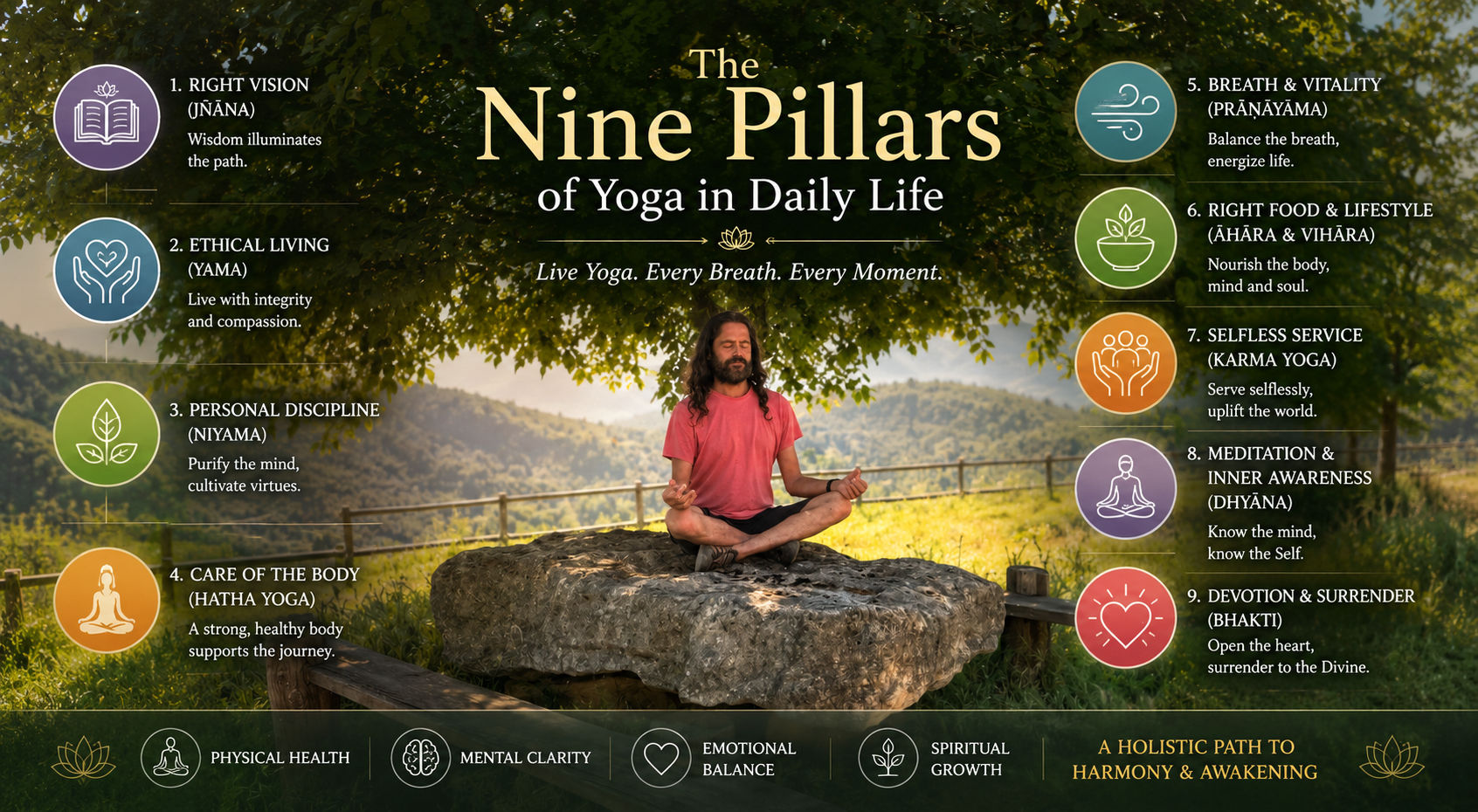
The Nine Pillars of Yoga in Daily Life

The Nine Pillars of Yoga in Daily Life
Yoga is far more than a series of physical postures. It is a complete way of living that integrates the body, breath, mind, heart and spirit. The ancient yogic sages taught that every thought, every action, every relationship and every moment of awareness can become an expression of Yoga.
The Nine Pillars of Yoga in Daily Life provide a practical framework for bringing yogic wisdom into everyday living. Rather than limiting Yoga to the practice mat, these timeless principles help cultivate physical health, mental clarity, emotional balance and spiritual awakening.
The Bhagavad Gītā describes Yoga as skill in action (Yogaḥ Karmasu Kauśalam), equanimity (Samatvam Yoga Ucyate) and ultimately as union with the Divine. These nine pillars offer a holistic path for embodying these teachings in daily life.
Learning Objectives
By the end of this lesson you will be able to:
Understand the nine essential pillars that support a balanced yogic lifestyle.
Apply yogic principles beyond physical practice and into everyday living.
Integrate ethics, body, breath, meditation, devotion and wisdom into daily routines.
Develop habits that promote physical wellbeing, emotional resilience, mental clarity and spiritual growth.
Why These Nine Pillars Matter
Every aspect of life influences our wellbeing and spiritual evolution. Our thoughts shape our actions, our actions shape our character, and our character shapes our destiny.
The Nine Pillars help us develop:
Greater self-awareness
Healthier relationships
A calmer and more focused mind
Increased vitality and resilience
A deeper connection with our true nature
Harmony between worldly responsibilities and spiritual growth
Together they form a complete blueprint for living Yoga every day.
1. Eka Stambham – Right Vision (Dṛṣṭikoṇa & Jñāna)
“See life as sacred.”
Every journey begins with understanding. When we understand who we are and why we are here, our choices naturally become wiser and more aligned with Dharma.
Develop knowledge of:
Dharma – discovering our true purpose and highest potential.
Karma – understanding the consequences of our physical, mental, emotional and verbal actions.
Ātman – recognising our true Self beyond body and mind.
Adhyātma – cultivating spiritual awareness and connection with the inner Self.
Brahman – understanding universal Divine Consciousness.
Prakṛti – recognising the nature of the mind and material existence.
The sacred purpose of human birth.
Daily Practice
Read uplifting spiritual literature.
Reflect before making important decisions.
Ask yourself:
“Will this action create harmony or suffering?”
Scriptural Reflection
“As blazing fire reduces wood to ashes, so does the fire of knowledge burn all karma.”
Bhagavad Gītā 4.37
2. Dwi Stambham – Ethical Living (Yama)
Ethics are the foundation of inner peace and harmonious relationships. Living ethically creates balance within ourselves and the world around us.
Practice the Five Yamas
Ahimsa
Non-violence in thoughts, words and actions.
Satya
Living with truthfulness, honesty and authenticity.
Asteya
Not taking what does not belong to us, while cultivating gratitude and respect.
Brahmacharya
Wise management of our life force and sensory energies through moderation and balance.
Aparigraha
Freedom from greed, excessive accumulation and attachment to possessions, memories and past experiences.
3. Tri Stambham – Personal Discipline (Niyama)
Inner transformation requires conscious self-discipline and continuous self-development.
Practice the Five Niyamas
Śauca
Purity of body, mind, emotions and actions.
Santoṣa
Cultivating contentment, gratitude and inner fulfilment.
Tapas
Consistent disciplined effort that supports personal evolution.
Svādhyāya
Self-study through scripture, reflection, Satsanga and self-enquiry.
Īśvara Praṇidhāna
Offering every action to the Divine and surrendering the fruits of our efforts.
4. Chatur Stambham – Care of the Body (Haṭha Yoga)
“The body is the temple of Consciousness.”
The body is the vehicle through which we experience life and spiritual practice. Caring for it with awareness allows energy to flow freely and prepares the mind for meditation.
Regular practice develops:
Flexibility
Strength
Healthy circulation
Good posture
Balance
Vitality
Daily Practice
Sukṣma Vyāyāma
Classical Āsanas
Sūrya Namaskāra
Relaxation and Yoga Nidrā
The purpose of āsana is not physical perfection but stability, comfort and inner stillness.
Sthira Sukham Āsanam
“Posture should be steady and comfortable.”
Yoga Sūtras 2.46
5. Pancha Stambham – Mastery of Breath & Vitality (Prāṇāyāma)
Breath is the bridge between body and mind.
When the breath becomes calm, the mind naturally follows.
Regular Prāṇāyāma helps to:
Balance the nervous system
Improve concentration
Increase vitality
Calm emotional disturbances
Enhance mental clarity
Daily Practice
Savitrī Prāṇāyāma
Sukha Prāṇāyāma
Nāḍī Śodhana
Bhrāmarī Prāṇāyāma
Throughout the day, simply observing the breath develops mindfulness and inner balance.
6. Ṣaṭ Stambham – Right Food & Lifestyle (Āhāra & Vihāra)
Everything we consume influences our consciousness—not only food, but also thoughts, emotions, relationships and environments.
Ayurveda reminds us:
“We become what we repeatedly consume.”
Yogic Lifestyle Guidelines
Choose:
Fresh, seasonal and wholesome foods.
Moderate portions.
Mindful eating.
Peaceful surroundings during meals.
Also cultivate:
Proper sleep
Regular daily routines
Moderation in all activities
Time in nature
Healthy relationships
Periods of silence and reflection
The Bhagavad Gītā teaches moderation in eating, sleeping, work and recreation as essential for successful Yoga.
7. Sapta Stambham – Niṣkāma Karma Yoga (Selfless Service)
Our work becomes Yoga when performed without selfish attachment.
Serve with love and humility:
Family
Community
Nature
Society
Humanity
Daily Practice
Help someone without expecting recognition.
Volunteer your time.
Share knowledge generously.
Offer every action to the Divine.
“You have the right to action alone, never to its fruits.”
Bhagavad Gītā 2.47
8. Aṣṭa Stambham – Meditation & Inner Awareness (Dhyāna)
Meditation is the art of knowing the mind and discovering the Self.
Through regular meditation we cultivate:
Awareness
Peace
Intuition
Compassion
Emotional balance
Equanimity
Daily Practice
Quiet sitting
Breath awareness
Mantra Japa
Chakra meditation
Witness consciousness (Sākṣī Bhāva)
Even ten to twenty minutes each day can profoundly transform our inner life.
9. Nava Stambham – Devotion & Surrender (Bhakti)
The heart completes what the intellect begins.
Devotion softens the ego, opens compassion and transforms every action into worship.
Cultivate
Gratitude
Prayer
Mantra chanting
Kīrtana
Worship
Loving surrender
See the Divine in every person, every experience and every moment.
“Whatever you do, whatever you offer, whatever you give, do it as an offering unto Me.”
Bhagavad Gītā 9.27
Daily Self-Reflection
At the end of each day, take a few quiet moments and reflect:
Did I live according to Dharma today?
Were my words truthful, kind and compassionate?
Did I care for my body, breath and mind?
Did I act selflessly without expectation?
Did I spend time in meditation or self-reflection?
Did I express gratitude today?
What did I learn about myself?
Where can I improve tomorrow?
Did I remember the Divine in my thoughts and actions?
Key Scriptural References
Bhagavad Gītā – 2.47, 2.48, 3.19, 4.37, 6.16–17, 9.27, 12.13–20, 18.66
Patañjali Yoga Sūtras – 2.29, 2.30–2.32, 2.46–2.53
Īśā Upaniṣad
Kaṭha Upaniṣad
Taittirīya Upaniṣad
Haṭha Yoga Pradīpikā – Chapters 1–4
Closing Reflection
Yoga is not confined to a class, a posture or a meditation cushion—it is a way of living. Every breath, every thought, every meal, every conversation, every act of kindness and every moment of awareness offers an opportunity to practise Yoga.
By cultivating these Nine Pillars of Yoga in Daily Life, we gradually transform our actions into conscious living, our habits into spiritual practice and our lives into an expression of Dharma. As wisdom deepens, service becomes natural, meditation becomes effortless and devotion blossoms. Yoga then ceases to be something we do and becomes the very essence of who we are.


Comments